
The March 2026 Authenticity Update rewired how LinkedIn's algorithm distributes content. Most founder advisors are still running 2023 playbooks.
Your reach is down 50% year-over-year. Your engagement dropped 25%. Follower growth collapsed 59%. These aren't temporary dips tied to market conditions or platform decay. LinkedIn fundamentally changed what gets amplified.
The founders winning right now aren't publishing more. They're publishing differently.
The 2026 LinkedIn Reckoning
LinkedIn killed three things that used to work.
The Momentum Model is gone. You used to have a golden window in the first 90 minutes after posting. If your content hit engagement thresholds fast enough, the algorithm would amplify it to your extended network. Timing mattered more than quality. That system evaporated in March.
The Authenticity Update neutered engagement bait. LinkedIn's AI now detects posts designed to game metrics instead of deliver value. "Tag someone who..." posts get buried. Polls designed to farm comments get suppressed. The algorithm sees the intent, not the format.
Algorithm trust shifted from reach-first to profile-first. LinkedIn built a 150-billion-parameter model called 360Brew that evaluates your entire profile before deciding whether to amplify a single post. One bad post doesn't tank you. But a consistent run of bad posts, off-niche content, or inauthentic behavior does.
These changes compound. If you're still operating under old rules, you're training the algorithm to ignore you.
How the 360Brew Algorithm Works
360Brew runs five filters on every post you publish.
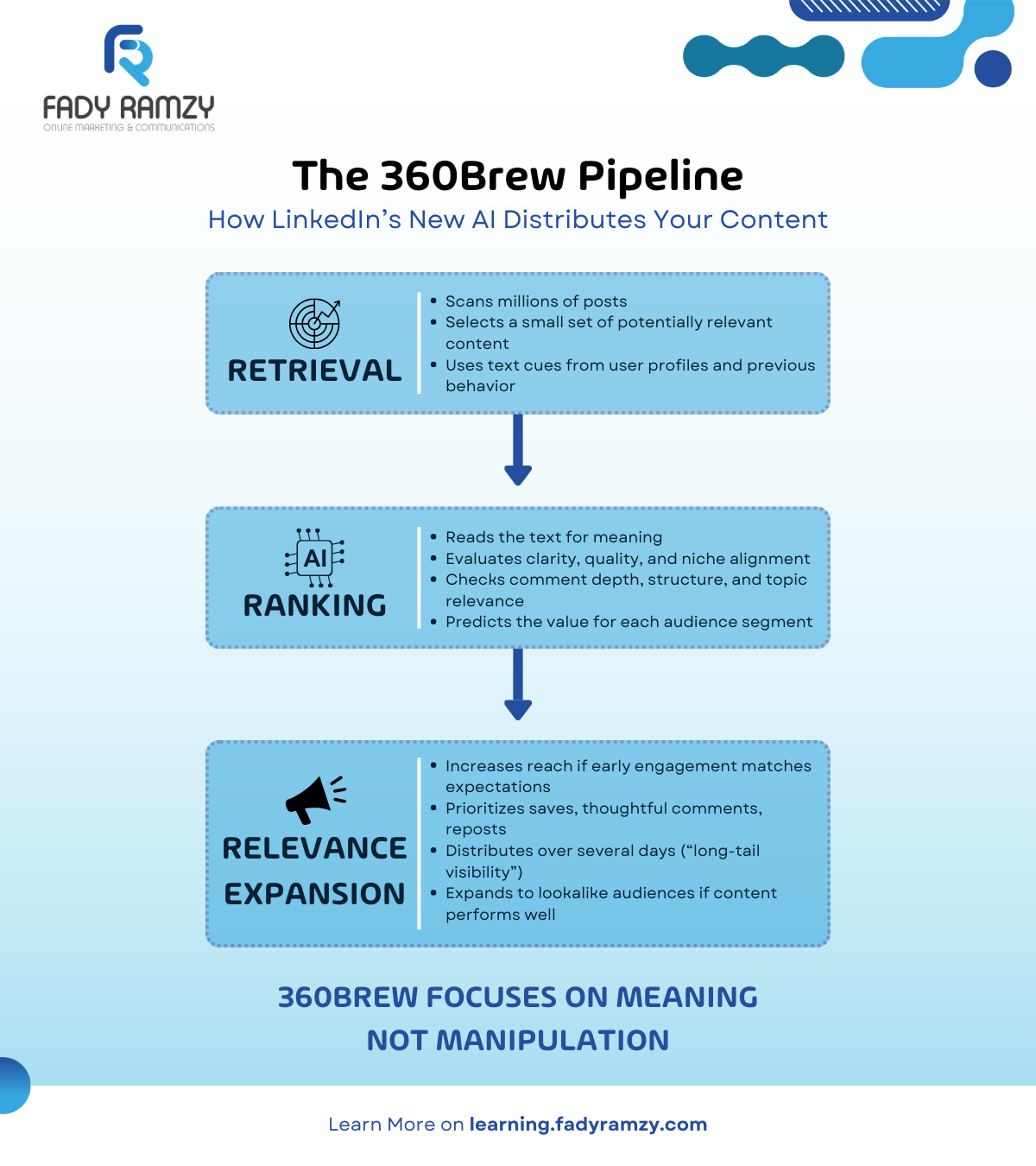
Profile coherence is first. The model scans your last 100 posts, your headline, your profile description, and your follower composition. It's asking one question: Does this person have a defined point of view? If your posts jump from founder advice to fitness tips to random reactions, 360Brew categorizes you as a noise account. Noise accounts get half the distribution of coherent accounts.
Content niche evaluation is next. LinkedIn's model knows that someone posting about SaaS metrics should have an audience of founders, operators, and investors. If that same account suddenly posts about cryptocurrency speculation, the algorithm detects the mismatch. Off-niche posts get suppressed regardless of engagement because they signal lack of expertise or authenticity.
Dwell time measurement is where creators fail. A post gets 61+ seconds of reading time before a user scrolls past, and it hits 15.6% engagement. The same post at 0-3 seconds generates 1.2% engagement. But dwell time isn't about post length. It's about stopping power. A dense, jargon-filled 500-word post gets scrolled past in 4 seconds. A short, specific post that creates friction and makes readers pause can hold attention for 90 seconds.
Comment quality assessment runs below the surface. LinkedIn's model doesn't count comments equally. A comment from someone with 50k followers in your niche carries 7-9x more weight than a comment from a random account. A comment that adds new information carries 15x more weight than a like. Engagement pods get detected and shadow-banned because the activity looks algorithmically impossible.
Engagement analysis is the final filter. The algorithm tracks whether your growth comes from real network effects or artificial tactics. If you post at midnight and get 500 likes in the first 8 minutes from a consistent set of accounts that never comment, you're tagged. That shadow ban doesn't delete your posts. It quietly reduces their distribution to 10-15% of your normal reach.
360Brew runs all five filters simultaneously. A single post triggers dozens of sub-evaluations. The algorithm assigns a reach coefficient. Posts that fail multiple filters get 0.15-0.4. Posts that nail all five filters get 1.5-2.0.
Personal Profiles Destroy Company Pages
This stat is worth staring at: personal profiles generate 561% more reach than company pages posting identical content.
A company page founder announcement reaches 1.6% of your followers organically. A founder posting the same announcement from their personal profile reaches 4.5-9.0% of their followers. The gap between viable and pointless.
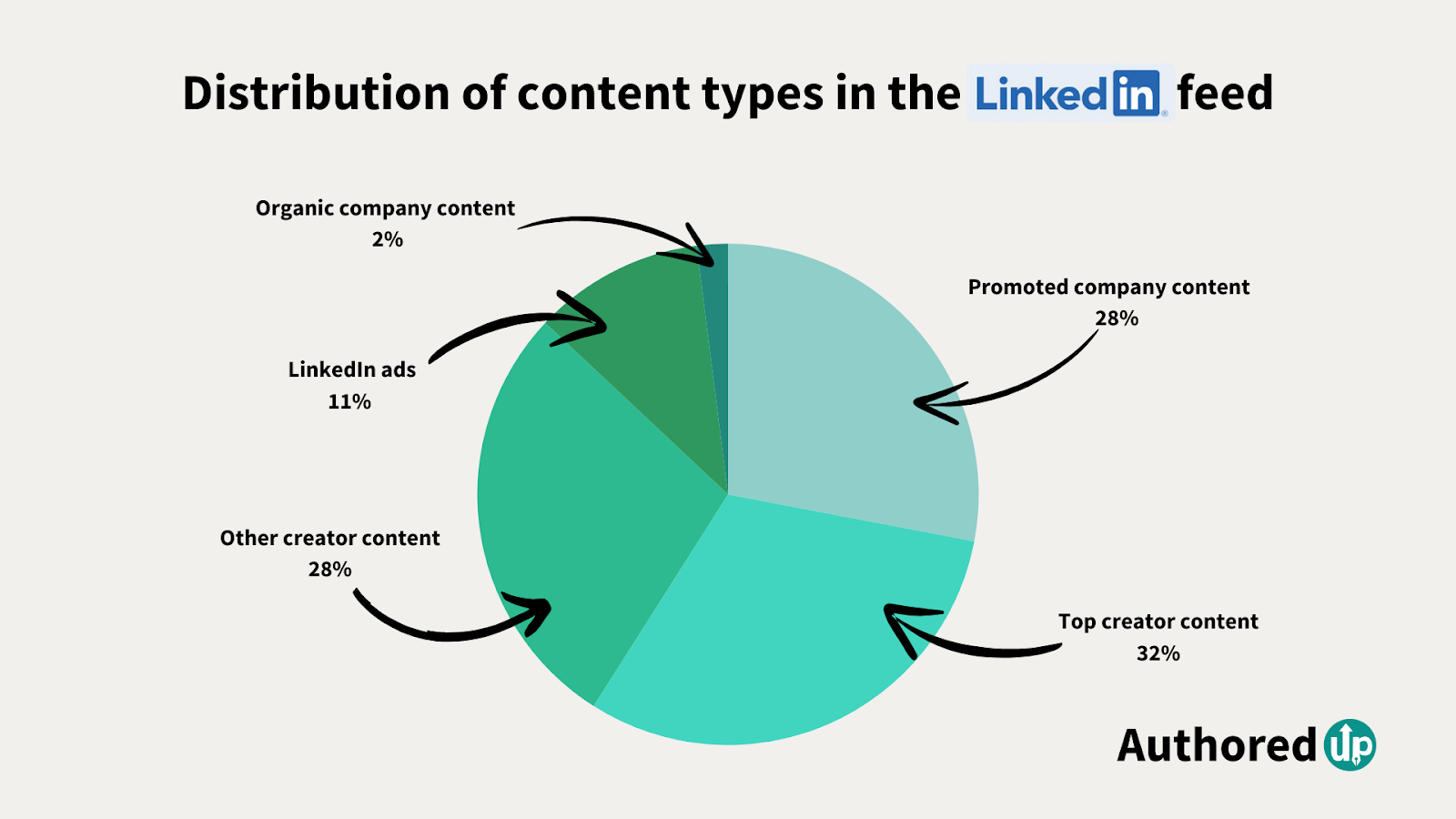
Personal profiles dominate 65% of feed allocation. Company pages get 35%. LinkedIn's internal research shows that users engage 2.75x more with personal profiles and 5x more when the person has proven expertise. The platform built an incentive structure: profiles win. Pages lose.
This breaks how founders think about company building. Your company page should exist for recruiter credibility. But your personal profile is your reach asset. The algorithm trusts humans more than institutions.
Founders who post company milestones from their personal profile with context and narrative see 8-15x more reach than posting the same content from the company page.
Document Posts Hit 7% Engagement
The format hierarchy on LinkedIn in 2026 looks like this.
Documents: 7% engagement. Native LinkedIn documents get the highest reach. Users spend time reading them inside the feed. The algorithm counts every second of dwell time. Video: 5.1% engagement. Multi-slide carousels: 6.6% engagement. Polls: 4.4% engagement. Text: approximately 4% engagement.
Document posts work because of dwell time. A user opens a text post, reads two sentences, scrolls. Total time: 6 seconds. That same user opens a document post, sees structured formatting, spends 45-90 seconds reading and processing. The algorithm's dwell time meter is running the entire time.
The first three lines before "See More" are everything. Users see the title and the first three lines in the feed. If those lines don't create friction, don't make them pause, they click away. If those lines make them curious enough to click "See More," dwell time explodes.
Contrast works. Specific numbers work. Contradiction works. "We fired 40% of our team and revenue went up" stops scrollers. "SaaS margins are collapsing" stops scrollers.
Structure matters inside the document. Dense paragraphs get scrolled. Line breaks work. Lists work. A 2,000-word document structured with rhythm and white space will outperform a tight 800-word block of text.
The Dwell Time Playbook
Dwell time is the operating principle of the 2026 algorithm. Everything else is downstream from it.
The first 3 lines before "See More" function as a doorway. Users scrolling the feed see your name, your headline, and your first three lines. That's the total information they process in 1-2 seconds. If those three lines don't promise value, specificity, or surprise, they scroll.
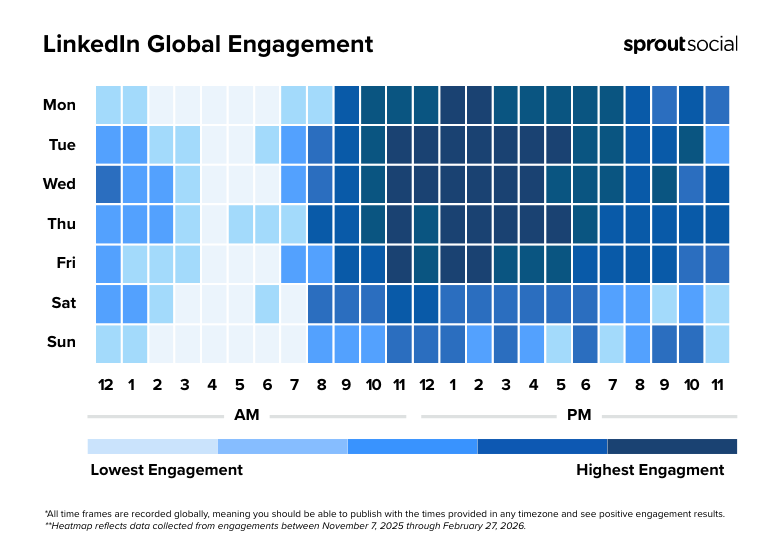
Comment velocity within 90 minutes triggers amplification. A post published at 10 AM that gets 10 comments by 11 AM signals early engagement. The algorithm routes it to 20% more people. A post published at 10 AM that gets those same 10 comments spread across 6 hours signals weak appeal. It gets routed to 8% fewer people.
45-90 seconds of reading time is the sweet spot for maximum reach. A post that holds attention for 2+ minutes gets less amplification because fewer users finish it, and the algorithm interprets incompleteness as lower relevance. The target is holding 60-70% of people who click "See More" for the full duration.
70% of LinkedIn users are ghost scrollers who never engage visibly. They read. They don't comment or like. The algorithm counts their dwell time. A post that resonates with ghost scrollers gets amplified even if the visible engagement is low. You're writing for the 70% who read and decide whether you're worth following.
Positioning comes before posting. Book a 15-min fit call
Why Comments Beat Posts for Reach
Publishing is optional. Commenting is the real lever.
A meaningful comment is worth 15x more than a like. An expert interaction is worth 7-9x more algorithmic weight than an average comment. A person spending 15 minutes per day writing five high-quality comments on relevant posts sees more profile views, more followers, and more DMs than a person spending 90 minutes per day publishing.
LinkedIn's internal research calls this "invisible posting." A founder who writes 5-10 meaningful comments per day across relevant posts gets treated as an active participant in their niche. The algorithm tracks their comment activity, sees they're genuinely engaged with the community, and routes their future posts to larger audiences as reward.
The mechanics work like this. You comment on a post in your niche. Your comment adds a new perspective or data point. Users see your name and profile in the comments. They click. Some follow. The algorithm logs the interaction. When you later publish, the algorithm says: "This person has credibility in this niche. Route their content wider."
The time equation is stark. 15 minutes of focused commenting on five posts beats 90 minutes spent writing and editing a new post. The post might get 100 engagements and 2,000 impressions. The comment work might drive 300 profile views, 12 followers, and 3 genuine DMs from potential collaborators.
Niche Authority Over Broad Reach
Broad audiences are easier to grow and harder to monetize. Niche audiences are harder to grow and easier to monetize.
LinkedIn now rewards niche authority explicitly. 360Brew calculates a Relevance Score that measures whether your audience engagement aligns with your niche. If you post about SaaS metrics and 85% of your engagement comes from SaaS founders, operators, and investors, your Relevance Score is high. You get normal distribution.
Posting outside your lane kills algorithm trust. A SaaS founder who posts about SaaS for three weeks then suddenly posts about personal finance sees their Relevance Score drop 30-40%. The next three posts in your actual niche get routed to 25% fewer people as the algorithm recalibrates.
The compounding effect is real. Micro-specialization builds compound trust. A founder who owns "SaaS CAC reduction" specifically gets routed to people searching for that exact problem. Over 12 months, the Relevance Score climbs 4-5% per quarter. By month 12, you're reaching 1.8x the audience of a founder with broader positioning, even if you both have the same follower count.
Narrowing your positioning feels like limiting your audience. It actually increases your reach because you're concentrating your message to the exact people who care.
Bookmarks as the Silent Ranking Signal
Bookmarks matter more than likes. Saves drive 5x more reach than likes and 2x more reach than comments.
A save signals high intent. A user who likes your post engaged for 2-5 seconds. A user who saves your post is saying: "I'm keeping this. I'll reference it later." That's a different signal. That's someone who trusts your content enough to store it permanently.
LinkedIn's algorithm treats saves as the highest-intent engagement signal. Posts with high save-to-like ratios drive follow-ups and DMs at 3x the rate of posts with high comment counts.
Engineering posts for bookmarking means building utility into the content. Share a framework people want to reference later. Share data that might be useful in six months. Share a checklist or process. These posts get saved. Posts designed to spark immediate reaction get liked and scrolled past.
What Hurts Your LinkedIn Reach
Some tactics work slowly against you. Others suppress your reach immediately.
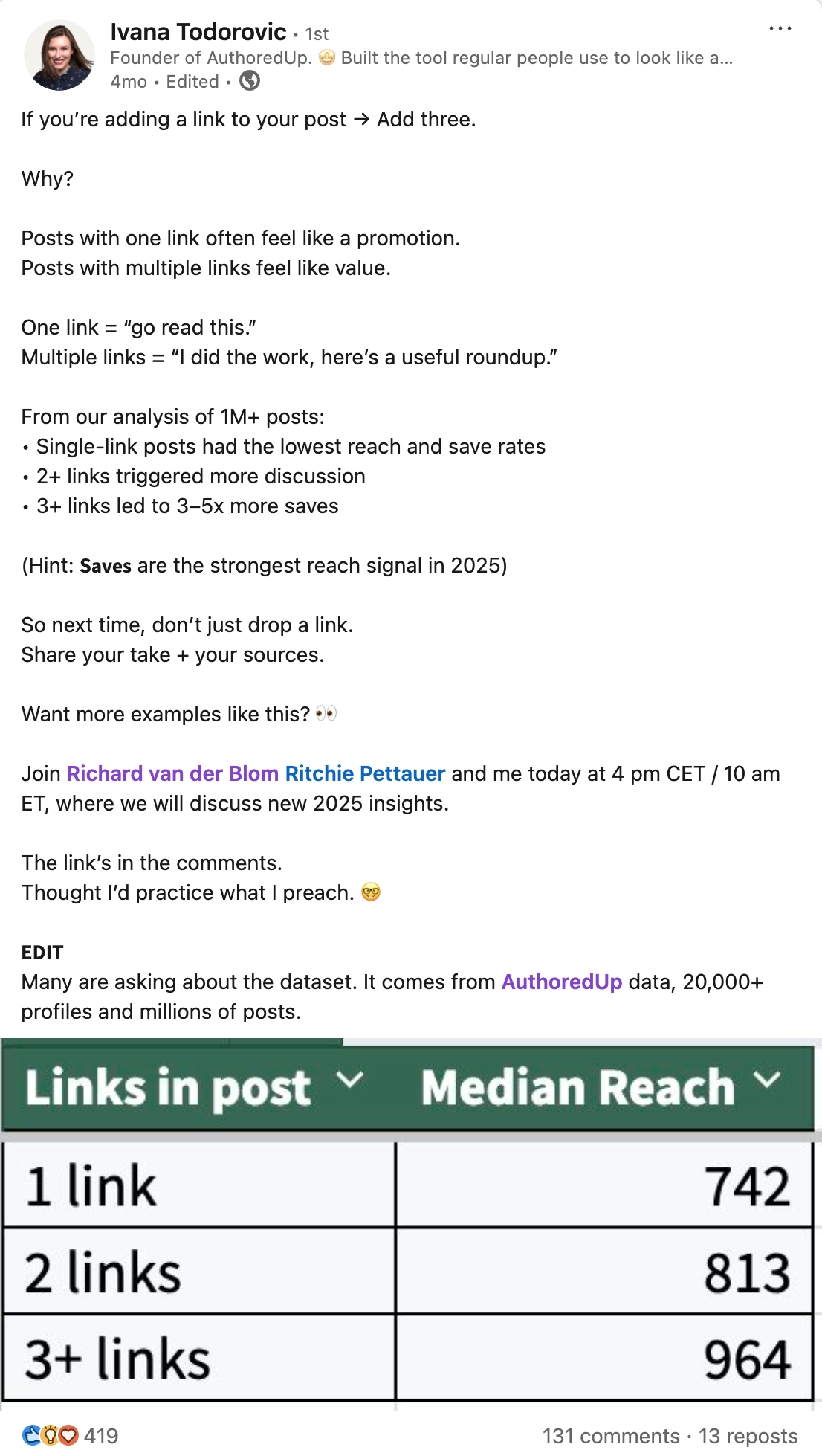
External links trigger a 60% reach penalty. Post a link to a blog post on your website, and the algorithm routes your post to 60% fewer people than an identical post with no link. LinkedIn wants engagement to stay on the platform.
Engagement pods are shadow-banned. If you're in a Slack group of 50 creators who agree to like and comment on each other's posts within the first hour, LinkedIn detects it. All your posts from that point forward get routed to 70-85% fewer people. The ban is invisible.
Three or more hashtags in a single post trigger 70% lower reach. One or two hashtags are neutral. Three or more is a spam indicator.
Engagement bait destroys reach. "Tag someone who..." posts, "Like if you agree" posts, and "Comment with your answer" posts all get suppressed. The algorithm interprets these as games designed to farm metrics instead of deliver value.
Generic AI-generated content gets downranked. LinkedIn doesn't ban AI content. It deprioritizes it. Perfectly polished content with no unique voice, no specific examples, and no risk gets routed to fewer people.
The Authority Stacking System
This is the framework that works. It compounds over time.
Layer 1 is defining your niche. A "founder" is too broad. "SaaS founder solving CAC problems for B2B companies" is tight. "Early-stage founder going from $0 to $1M ARR" is tight. Specificity is the entry point.
Layer 2 is value-first content. Publish four posts per week: Tuesday through Friday. The four-post sequence should be: framework post, case study post, mistake post, contrarian take post. Framework posts build authority. Case study posts build credibility. Mistake posts build trust. Contrarian posts build conviction.
Layer 3 is engineered meaningful comments. Spend 15 minutes every day commenting on five posts in your niche. Your comments should add a new perspective or data point. Over 30 days, that's 150 comments. Over 12 months, that's 1,800 comments. The algorithm logs every single one.
The three-layer system compounds. Layer 1 defines who you are. Layer 2 demonstrates what you know. Layer 3 proves you're engaged with the community. Together, they build algorithmic trust faster than publishing alone ever could.
The 60-Day LinkedIn Authority Playbook
Apply this in sequence. The order matters.
Weeks 1-2: Profile optimization. Rewrite your headline to include your niche. Rewrite your about section to show your specific positioning. Audit your last 50 posts. If more than 20% are outside your niche, consider archiving them. Cleaning up off-niche content improves your Relevance Score immediately.
Weeks 3-4: Niche authority launch. Publish your first framework post. Make it specific. Follow with a case study post, then a mistake post, then a contrarian post. You're establishing your voice and your positioning simultaneously.
Weeks 5-6: Document post strategy. Convert one of your four weekly posts into a document post. Use the first three lines to create friction. Target 45-90 seconds of reading time. Test different opening approaches.
Weeks 7-8: Comment engagement routine. Start the 15-minute daily comment protocol. Find five relevant posts per day. Write meaningful comments. The algorithm is watching.
Weeks 9-12: Momentum exploitation and refinement. By week 9, your Relevance Score has climbed. Your comments are driving profile views. Publish your strongest framework content. This is when the algorithm routes your content widest because you've built trust. Double down on what works. Kill what doesn't.
At the end of 60 days, you should have a coherent profile, four weeks of publishing momentum, 150+ comments logged in the system, and 50-100 new followers who actually care about your work