
Most founders treat content like a treadmill. Write a post, ship it, watch it die by lunch, then start again tomorrow with nothing banked.
That is the most expensive way to build a personal brand. You spend your scarcest hours making net new ideas while the idea that worked last week never gets a second look.
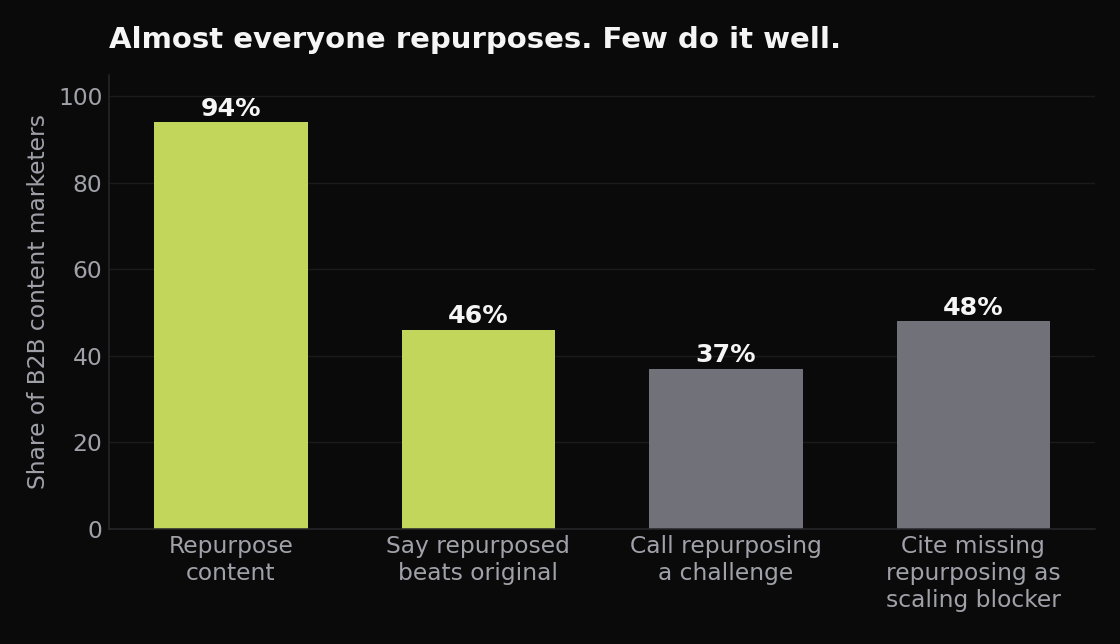
94 percent of content marketers repurpose their content across formats and channels. Yet 37 percent of B2B marketers still call repurposing a challenge, and 48 percent name a lack of repurposing as the reason their content never scales. The habit is common. The system is rare.
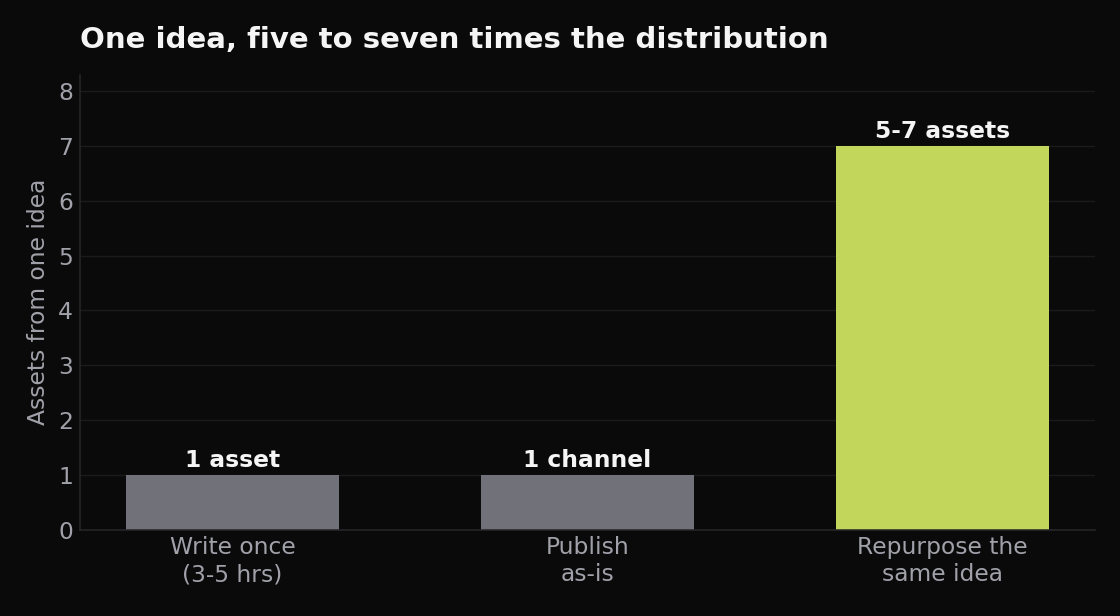
Content repurposing for founders is a system that turns one sharp idea into five to seven distribution assets aimed at the same buyers. The goal is never more posts. The goal is the same proof landing in front of named accounts until recognition becomes a conversation.
The Founder Content Treadmill That Burns Pipeline
The treadmill feels productive. You post daily, you stay busy, you watch the likes trickle in.
Underneath, you are trading your rarest resource for your cheapest outcome. A solid long-form idea takes three to five hours to think through and write. Founders spend that on a single post, run it once, and throw it away.
Then they do it again the next day. And the day after. The output looks like consistency. The economics look like a leak.
Meanwhile the founder next door writes one strong idea a week and spends the rest of the week putting it in front of buyers seven different ways. Same input. Seven times the surface area.
Make today's labor tomorrow's leverage. On the treadmill, today's labor dies by tomorrow.
Repurposing for Pipeline Over Reach
Most repurposing advice is reach advice. Reformat the blog into a carousel, chop the webinar into clips, cross post everywhere, and chase impressions across channels.
Reach feeds the ego. Pipeline feeds the business.
Repurposing for pipeline flips the target. You are not spreading one idea to more strangers. You are landing one proof point in front of the same buyers in more places, so a named account sees your stance on Monday, your case study on Wednesday, and your bridge on Friday.
Repetition builds recognition. Recognition builds trust. Trust books the call.
The reformatting is identical either way. The intent is what separates a founder who trends for a day from a founder who fills a pipeline for a quarter.
The Build Once Sell Twice Content Engine
Every repurposing system starts with one rule. Build the asset once. Sell the asset many times.
The engine runs on four inputs. Miss one and the repurposing has nothing worth repeating.
A stance. One sentence only you would say. "Founder-led content beats brand-account content at deal sizes above 25K because trust transfers faster from a person than from a logo."
A proof. A named outcome with a specific number. "We closed seven enterprise deals in six months on inbound from one founder posting three times a week."
A framework. A repeatable structure a buyer can steal and run. The stance without a framework is a slogan. The framework makes it useful.
A bridge. One next step. A single trigger word, a tracked link, a specific ask. Every repurposed piece points at the same door.
Build those four once inside a strong piece of content. Now you have raw material that survives being cut a dozen ways.
How to Turn One Idea Into Seven Assets
One article carries more than one post inside it. Learn to see the parts.
The stance becomes a standalone declarative post. Twelve words, no link, pure point of view.
Each proof point becomes a story post. Setup, tension, named number, lesson.
The framework becomes a carousel or a numbered breakdown. One slide per step.
A sharp paragraph becomes a text-only X post. A data point becomes a chart with one line of commentary. A contrarian line becomes a hook you test three different ways. The whole idea becomes a short raw video where you say it to camera in 60 seconds.
Seven children from one parent. Same three to five hours of thinking, spread across a week of touches instead of a single morning.
The Atomic Content Framework
Think of the long-form idea as a molecule. Repurposing is atomizing it into pieces that stand alone yet trace back to the same source.
Run every idea through three atomic layers.
Layer One the Anchor
The anchor is the heavy piece. A long-form post, an article, a recorded talk, a teardown. It holds the full stance, proof, framework, and bridge in one place.
You publish the anchor once. Everything else points back to it.
Layer Two the Atoms
The atoms are the standalone pieces cut from the anchor. Each one makes a single point and lands on its own.
One atom per proof point. One atom per framework step. One atom for the stance. One atom for the sharpest line. Five to seven atoms from one anchor, each engineered to be understood without the anchor next to it.
Layer Three the Echoes
The echoes are the same atoms reformatted for a second channel. The LinkedIn story becomes an X thread. The carousel becomes a short video. The data point becomes an email.
Anchor, atoms, echoes. One idea, three layers, a full week of distribution off a single sitting.
One Article Into a Week of Distribution
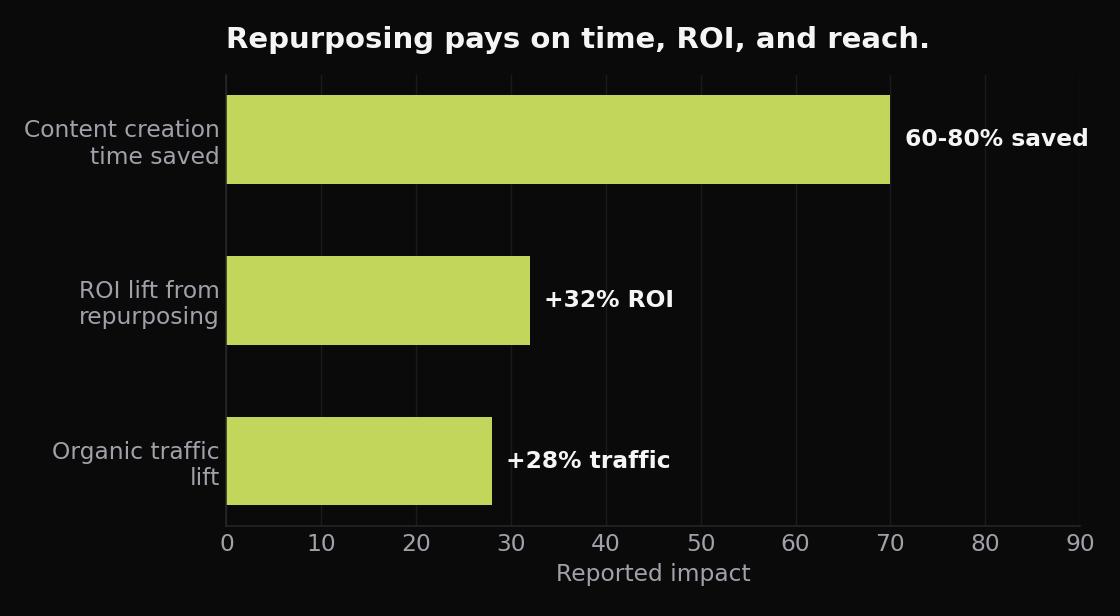
Repurposing saves 60 to 80 percent of the time it takes to build each piece from scratch. It lifts content ROI by an average of 32 percent, and 46 percent of marketers say the repurposed version outperforms the original. Lifecycle work on existing content raises organic traffic by 28 percent.
Those numbers say one thing. The second life of an idea usually beats the first.
Here is the week. Monday, publish the anchor. Tuesday, post the stance atom. Wednesday, post the first proof story. Thursday, ship the framework carousel. Friday, record the 60-second video. Over the weekend, the sharpest atom becomes an X thread and the data point becomes the Sunday email.
Seven touches. One idea. Same buyers watching the same proof stack up.
The buyer who ignored Monday's anchor stops scrolling on Thursday's carousel. The one who liked Tuesday replies to Friday. Compounding runs quietly while your competitor writes seven unrelated posts nobody remembers.
Why Distribution Beats Daily Creation
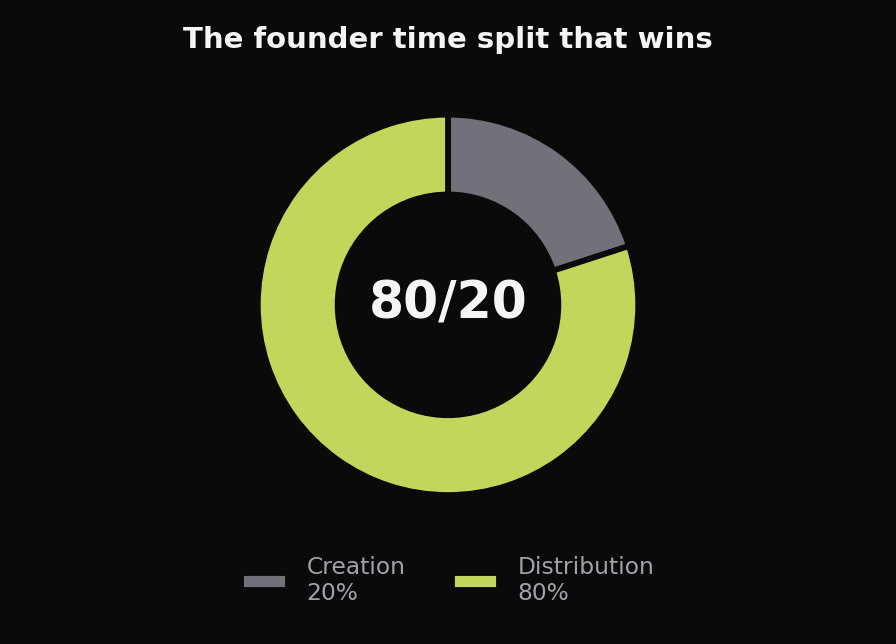
Noah Kagan built the sharpest split. Spend 20 percent of your time creating and 80 percent distributing.
Most founders run it backwards. They pour 80 percent into making new things and 20 percent into pushing them, then wonder why great ideas die quiet.
Repurposing is how you honor the 80/20 without burning out. You create less and distribute more, because one anchor gives you a week of things to distribute.
The founder who writes every day has no time to distribute. The founder who writes once a week has nothing but time to distribute. Guess which one buyers remember.
The 30 Day Founder Repurposing Build
Run the system as a sprint, never as a someday project.
Days 1 to 7 Pick the Anchors
List your four best customer wins and the stance behind each. Turn the strongest one into a long-form anchor with stance, proof, framework, and bridge. Publish it. Bank the other three as anchors in waiting.
Days 8 to 14 Atomize the First Anchor
Cut the published anchor into seven atoms. One stance atom, three proof atoms, one framework atom, one data atom, one hook atom. Schedule them across the next seven days so the same idea keeps landing.
Days 15 to 21 Add the Echoes
Reformat each atom for a second channel. LinkedIn to X. Carousel to video. Data point to email. Now one anchor covers two channels for two weeks.
Days 22 to 30 Measure and Repeat
Log which atoms pulled replies, which sourced conversations, and which sent buyers to the bridge. Publish anchor two. Run the same cut. The second sprint moves twice as fast because the parts are already named.
Thirty days in, you own a repeatable engine instead of a daily scramble. The same rhythm powers our founder content strategy playbook.
Three Repurposing Metrics Worth Tracking
Most founders track posts published. Posts published is the wrong number.
Track these three instead.
Assets Per Idea. How many distribution pieces one anchor produced. Below five and you are leaving leverage on the table. Seven and up means the engine is running.
Pipeline Per Idea. Qualified conversations sourced from an anchor and its atoms within 30 days. Tag every reply and every call by the idea that triggered it. This is the only number that maps to revenue.
Distribution Ratio. Time spent distributing versus time spent creating. Aim for the split that puts distribution on top. When creation outweighs distribution, the treadmill has you again.
Founders who watch these three run brands that compound. Founders who watch post count run brands that reset every morning.
Common Founder Repurposing Mistakes That Waste Leverage
Mistake One Creating Instead of Cutting
The point of repurposing is to stop making net new ideas every day. Founders who keep writing from scratch never bank the leverage. Cut the anchor. Do not rebuild it.
Mistake Two Spreading Instead of Stacking
Blasting one idea to more strangers chases reach. Landing one idea in front of the same buyers builds pipeline. Aim the atoms at the accounts that matter, not the widest crowd.
Mistake Three Copy Pasting Across Channels
An echo is a reformat, not a paste. The LinkedIn story needs different pacing than the X thread. Same idea, native shape. Lazy echoes read like spam and train buyers to skip you.
Mistake Four Atoms With No Bridge
An atom that makes a point and offers no next step entertains and exits. Every piece points at the same door. Proof earns attention. The bridge turns attention into a conversation.
Mistake Five Repurposing Weak Anchors
Seven copies of a soft idea is seven times the noise. Only anchor on ideas that carry a real stance and a named proof. Repurposing multiplies whatever you feed it, strength or weakness.
What to Ship This Week
You have one work block ahead. Total time, three hours.
Hour one. Pick your single best customer win and write the anchor. Stance, one proof with a real number, a framework a buyer can steal, one bridge. Publish it.
Hours two and three. Cut that anchor into seven atoms and schedule them across the next seven days. One stance, three proofs, one framework, one data point, one hook.
You will know inside two weeks whether the engine works. Watch Pipeline Per Idea, never post count.
Build once. Sell all week. Ship the anchor by Friday.